


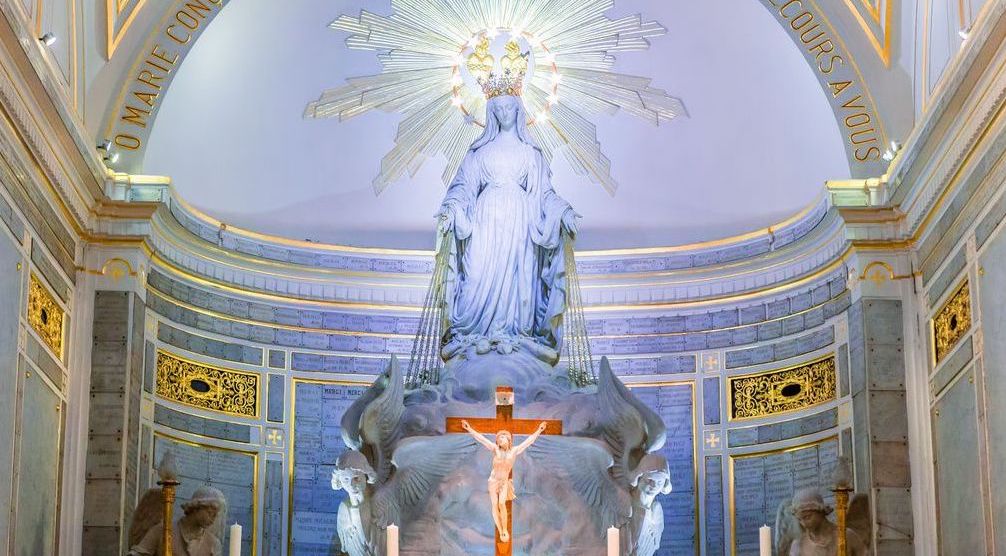
At the beginning of 2026, the jubilee marking 100 years of the First Saturdays of Fatima comes to an end. This jubilee has given new impetus to this great devotion to peace, and it is more essential than ever, in 2026, to continue to make it known and spread it everywhere.
We are also reminded of the recent Mater Populi fidelis Note, which raised so many questions about the roles and titles of the Blessed Virgin as Mediatrix and Co-Redemptrix.
The start of the new year is an opportunity to regain our peace and start afresh on a sound footing: nothing has changed, and these two doctrines remain fully enshrined in the Church’s constant and universal teaching. We can therefore maintain them serenely, in full obedience to the Church. A short (3-minute) explanatory summary is available below.
In this new year of 2026, let us entrust ourselves more than ever to the Blessed Virgin :
“My Immaculate Heart will be your refuge and the path that will lead you to God.”
Our Lady of Fatima, June 13, 1917
Salve Corda, 1st Saturdays of Fatima Alliance
Mary “Mediatrix” and “Co-Redemptrix”: why this doctrine remains unchanging
A short summary for the faithful
Par Salve Corda, Alliance around the 1st Saturdays of Fatima – www.salve-corda.org
(playback 3mins)
In October 2025, the Dicastery for the Doctrine of the Faith published the Note Mater Populi fidelis, raising many questions about the titles and doctrines of Mary Mediatrix and Co-Redemptrix. Without denying the title of Mother of God, the text tends to empty Mary’s unique and proper role in the work of Redemption of its substance, reducing her to that of a mere disciple.this Note has troubled many faithful, torn between their obedience to the Church and their faith in these roles of the Blessed Virgin. Fortunately, there is no need for such conflict, and the present synthesis aims to restore peace. It shows that preserving these roles of Mary is in fact a fully obedient attitude to the Church.
On the question of obedience, we can stress two preliminary points: 1/ The Pope signed the Note without forma specifica, which means that he authorized the publication of the text but without committing his own authority and therefore without granting it any binding force. 2/ These two doctrines on Mary have been taught regularly since the beginnings of the Church – Doctors, saints, popes – and are therefore part of the constant and universal Magisterium of the Church, whose teaching cannot be modified.
This Note from the Dicastery has no real magisterial scope, and the faithful can therefore legitimately disregard it, as several bishops and cardinals have already done. It does, however, offer a good opportunity to deepen our understanding of Mary’s two essential roles in our faith.

Mary, Mediatrix of all graces
It all begins in the Gospel, at the Visitation: it was thanks to Mary that the Savior was brought to Elizabeth and her family. This was her first act as Mediatrix of Christ’s grace. Then, at Cana, Mary again acts as Mediatrix, obtaining from Jesus His first miracle and the beginning of His public life.
This doctrine of Mediatrix was then taught over the centuries by numerous Doctors and Saints: Saint Ephrem the Syrian (4th c.), Saint Bernard of Clairvaux (12th c.), Saint Bonaventure (13th c.), Saint Bernardine of Siena (15th c.), Saint François de Sales, Saint Louis-Marie Grignion de Montfort, Saint Jean Eudes (17th c.), Saint Alphonse de Liguori (18th c.), Saint Maximilien Kolbe (20th c.) and many others.
“All graces are distributed by the hands of Mary. “ (Saint Bernardine of Siena, Sermones)
Many popes have validated this doctrine: Pius IX(Ubi Primum 1849), Leo XIII(Octobri mense, 1891), St. Pius X(Ad diem Illum, 1904), Benedict XV(Inter Sodalicia, 1918), Pius XI(Auspicia quaedam, 1948), Pius XII(Haurietis Aquas, 1956), Paul VI(Signum Magnum, 1967) and John Paul II(Redemptoris Mater, 1987).
“… by the Will of God, Mary is the intermediary through whom this immense treasure of graces accumulated by God is distributed to us.” (Leo XIII, Octobri mense, 1891)
Last but not least, this constant teaching of the Magisterium was confirmed by the Blessed Virgin herself during the acknowledged apparitions at rue du Bac (1830). On the Miraculous Medal, the rays of light streaming from Her hands represent the graces of Christ dispensed by Her:
“These rays are the symbol of the graces I pour out on those who ask me for them.” (Notre Dame, rue du Bac, November 27, 1830)
The correct doctrinal understanding of Mary as Mediatrix of all graces, as taught by saints and popes, raises no difficulties: God alone is the source of all graces, but He wished to dispense them to mankind through His Mother. Mary is not the origin, but the Mediatrix.
Mary Co-Redemptrix
Here too, Mary’s role is rooted in the Gospel, at the Annunciation and Passion (see explanation below). It was then taught from the earliest centuries by the Church Fathers, and later by numerous saints: Saint Irenaeus (2nd c.), Saint Ephrem (4th c.), Saint Ambrose (4th c.), Saint Bonaventure (13th c.), Saint Bernardin (15th c.), Saint François de Sales, Saint Louis-Marie Grignion de Montfort, Saint Jean Eudes (17th c.), Saint Alphonse de Liguori (18th c.), Saint John Henry Newman (19thc. ), Saint Maximilian Kolbe, Saint Padre Pio (20th c.). They all explained this doctrine, and some even used the title Co-Redemptrix.
“Thus Mary becomes one with Christ; she is the Co-Redemptrix of the human race. ” (Saint Maximilian Kolbe, Niepokalanów Conferences, 1937)
From the end of the 19th century onwards, popes in turn taught Mary’s role: Leo XIII(Octobri mense, 1891), Saint Pius X(Ad diem illum, 1904), Pius XII(Haurietis Aquas, 1956). Benedict XVI confirmed the doctrine, but did not use the word, while Benedict XV(Inter Sodalicia, 1918), Pius XI (speeches of 1933 and 1935) and John Paul II (speeches 1980 / 1996) explicitly used the title Co-Redemptrix.
“The Blessed Virgin, most intimately united with Christ the Redeemer, was also united with him in the work of the Redemption of the human race, as Co-Redemptrix. “(Pius XI, Oss. Romano, April 29, 1935)
The Co-Redemption is easier to understand than many other truths of the Catholic faith. There’s no point in refuting it on the grounds of “complexity”; all you have to do is explain it. Here is a summary accessible to all the faithful:
In the work of Redemption, the difference between the Blessed Virgin and Our Lord is infinite: Christ is the only Son of God and the only Redeemer. Mary, a human creature, cooperates in the work of Redemption, without being its origin, and in a role where Christ’s primacy remains complete.
But Mary’s role is totally unique and essential. There are two main reasons for this:
- Hisfree Fiat , without which the Incarnation – and, consequently, the Redemption – could not have been accomplished; this Fiat therefore lies at the very heart of the mystery of the Redemption.
“God wanted to wait for the Virgin’s consent, through which the world would receive salvation.” (Saint Thomas Aquinas, Expositio super salutatione angelica §3)
- Her perfect union with Christ’s sufferings, an absolutely unique union due to her maternal bond and the total purity of her Immaculate Heart. Saint John Eudes teaches that the Hearts of Jesus and Mary are so deeply united that they form, mystically, a single Heart.
“The pains of Mary’s Heart were so intertwined with those of Jesus that they formed a single martyrdom: the two Hearts suffered the Passion together, one in body, the other in soul”. (Saint Alphonsus Liguori, The Glories of Mary, II, 5)
We see that the simple notion of cooperation in salvation – which applies to all men – is not sufficient to express the unique theological nature of Mary’s role. Only the term Co-Redemption allows us to grasp its superior and essential character. The difference between the two is one of nature, not of vocabulary.
Conclusion
Saint Louis-Marie Grignion de Montfort admirably sums up the mission of the Blessed Virgin, as taught by the Church’s constant Magisterium: ” To Jesus through Mary”. This motto encompasses both doctrines.
As Mediatrix of all graces, Mary dispenses to our souls the graces we need to go to Jesus. Through her role as Co-Redemptrixshe brings us into a unique understanding of the mystery of the Cross, enabling us to unite ourselves more closely to the sufferings of her divine Son, who alone is the Redeemer and source of all graces.
For further information: https://salve-corda.org/fiche-3-analyse-de-la-international-marian-association/